
How To Make Facebook Ads Work for Your Wellness Practice, Without The Overwhelm
How To Make Facebook Ads Work for Your Wellness Practice, Without The Overwhelm
If you're a wellness practitioner who's tried Facebook ads and felt completely lost, you're not alone. Most people in your position feel the same way—overwhelmed by buttons, settings, and advice that seems to change every week.
Most business owners either don’t use Facebook ads or give up too soon. However, when used effectively, Facebook lead campaigns can help you attract more paying clients who are ready to take action.
Here's the good news: Facebook ads don't need to be complicated. The problem isn't that you're bad at tech or missing some secret formula. The real issue is that most people are working with a messy strategy and confusing structure.
You don't need ten different ad sets, complex funnels, or endless testing. You need a simple, clear system that actually makes sense—and that's exactly what this post will show you.
We're going to walk through a straightforward approach to running Facebook ads that generate real leads for your wellness practice.
You'll learn how to structure your campaigns, set a budget that makes sense, capture leads without fancy software, and track what actually matters so you don't panic and shut everything down too early.
Let's start with why most wellness practitioners struggle with ads in the first place.
Why Simple Ad Campaigns Work Better?
Most people fail at Facebook ads because they keep changing things. They'll run an ad for three days, see it's not "working," change the audience, rewrite the copy, adjust the budget, and start over. Then they do it again two days later.
This constant tinkering destroys your campaigns.
Here's why: Facebook needs time and data to learn what works. The platform's algorithm is actually pretty smart, but it needs stability to do its job.
When you keep changing everything, you're basically forcing Facebook to start from scratch over and over again.
Think of it like teaching someone to recognize your ideal client. If you keep changing the description every few minutes, that person will never really understand who you're looking for. Same thing happens with Facebook's system.
Over-optimizing too early kills performance. You see one day of high costs and freak out. You see a few low-quality leads and completely change direction.
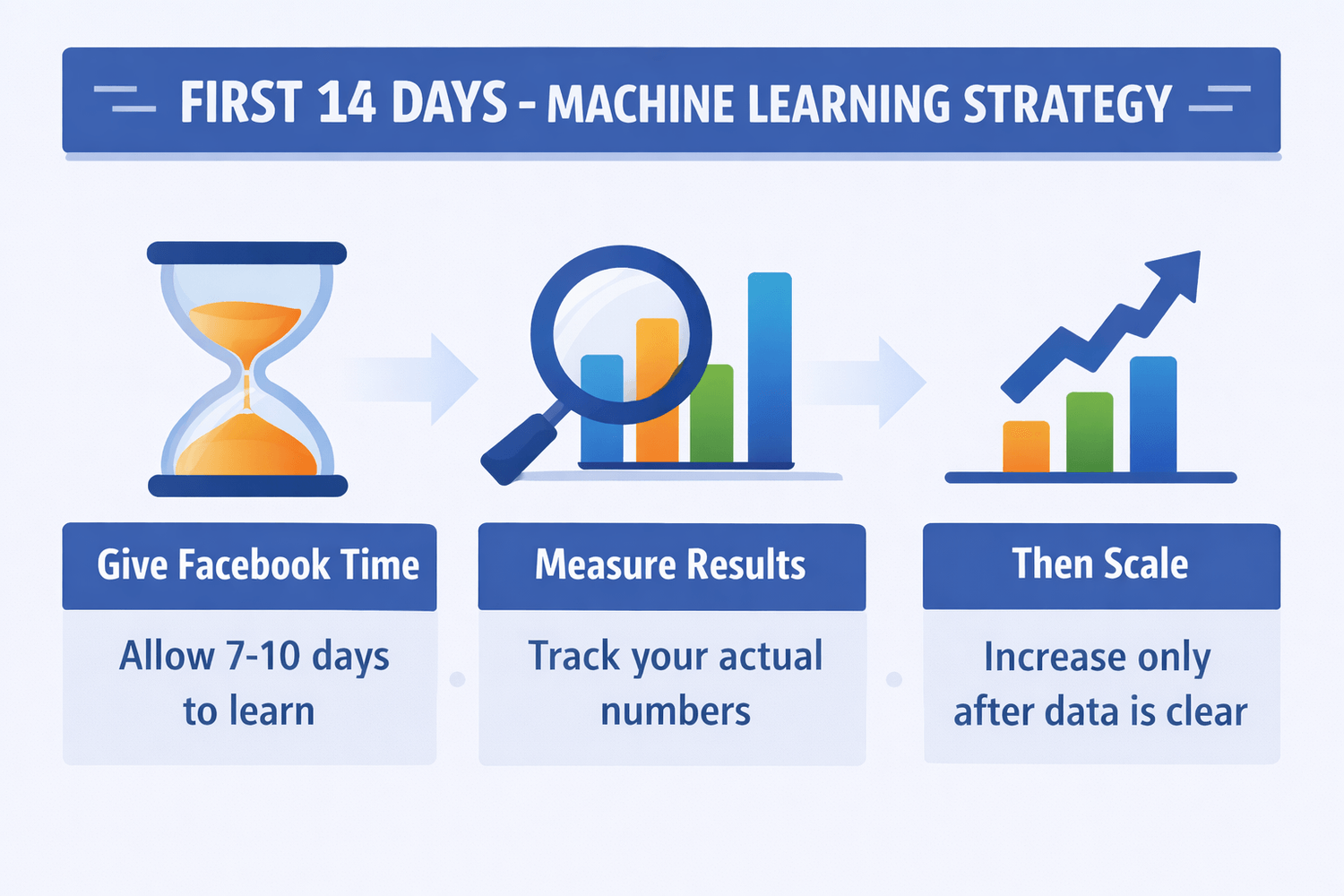
But here's what experienced advertisers know: the first few days or even weeks are often rough. That's normal. That's the learning phase.
A well-structured simple campaign will almost always beat an overly complex system. Why? Because simple campaigns are easier to understand, easier to manage, and easier to let run long enough to actually work.
This is where a lot of wellness practitioners get stuck. They think they need to be "sophisticated" with their ads. They see some guru talking about 47 different audience segments and custom conversion tracking and retargeting pixels for every page on their website.
What you need is a calm, strategic approach that gives Facebook time to work and gives you clear data to make smart decisions later..
What's the First Thing You Need Before Running Any Facebook Ad?
Before you spend a single dollar on Facebook ads, you need to answer one big question: What are we actually trying to do here?
This might sound obvious, but most people skip this step.
They jump straight into creating ads without a clear plan. And that's where things go wrong fast.
Facebook Ads Won't Fix a Missing Business Plan
Let's be clear about something right up front: Facebook ads are a tool. They're not a business plan.
If your offer isn't clear, if your messaging doesn't connect, if you don't know who you're trying to reach—ads will just expose those problems. They won't fix them.
Good ads amplify what's already working. They take your message, your offer, and your value and put them in front of more people.
But if those things aren't solid first, you're just spending money to show more people something that doesn't work.
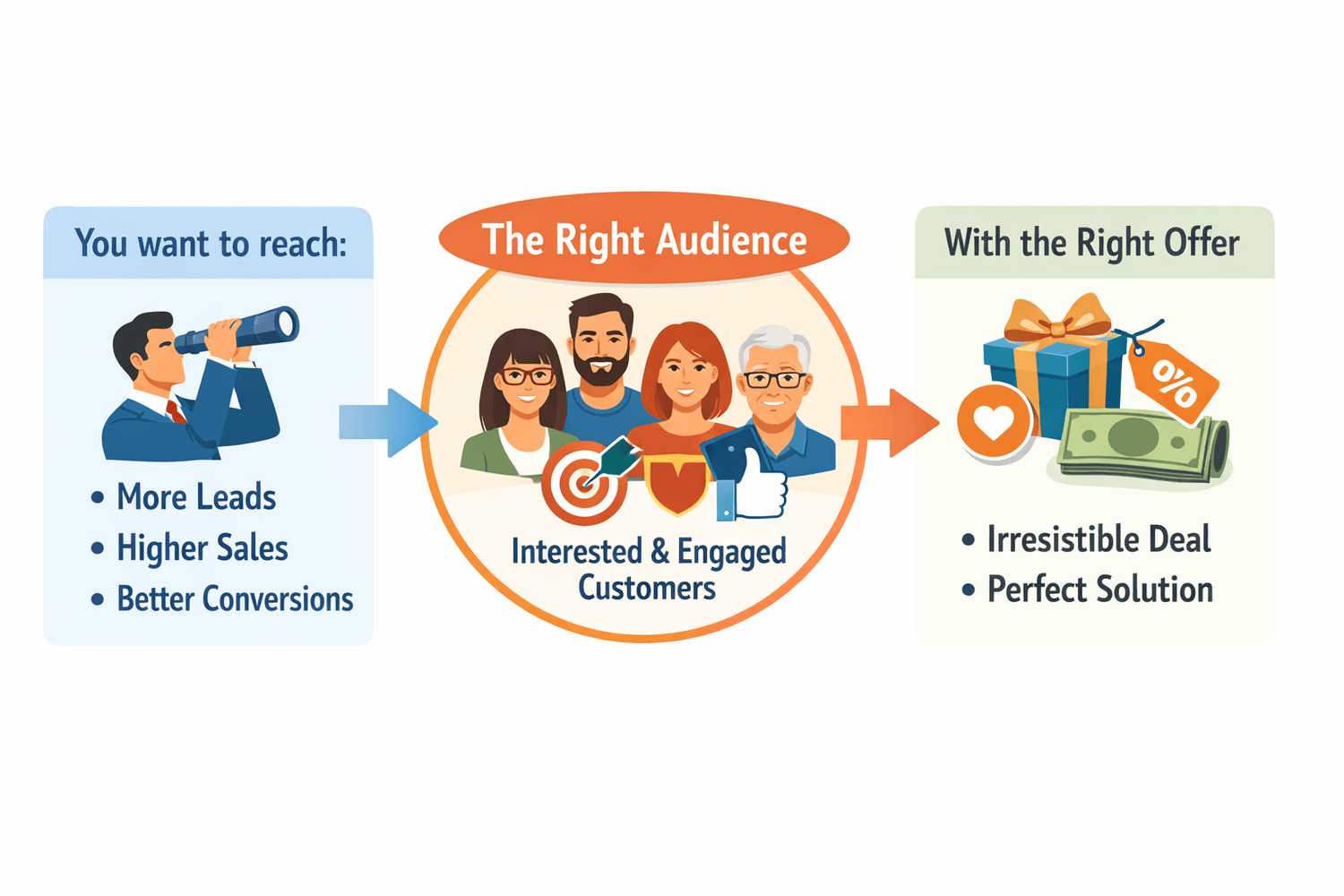
The real goal isn't "just get leads." Anyone can get leads. The goal is to create a predictable flow of people who are actually interested in what you offer and ready to have a conversation.
What Questions Should You Answer Before Starting?
Start with a simple strategic overview. Don't overthink this—just get clear on three things:
Who are we trying to reach?
Not "women aged 30-50 interested in wellness." That's not specific enough. Think about the actual person. What problem are they dealing with? What have they already tried? What keeps them up at night?
Where are they in their decision journey?
Are they just becoming aware that they have a problem? Are they looking for solutions? Are they comparing different practitioners or programs? Are they ready to book something this week?
This matters because what you say to someone who's just starting to look around is completely different from what you say to someone who's ready to hire someone.
What do they need next to move forward?
Maybe they need to understand their problem better. Maybe they need to see that solutions actually exist. Maybe they just need to know that you're accepting new clients.
Understanding this flow—from awareness, to trust, to taking action—will make everything else easier.
How Do You Pick the Right Campaign Objective?
Once you understand your audience and where they are in their journey, you need to pick ONE clear objective for your campaign.
Not three objectives. Not "let's try to do everything at once." One.
Here are some examples of real, useful objectives:
Build awareness so more people know you exist
Generate qualified leads who want to learn more
Get discovery calls booked on your calendar
Start conversations with potential clients
Fill spots in a specific program or service
Each of these is clear. Each of these can be measured. Each of these tells you exactly what success looks like.
Here's what doesn't work as an objective: "Get my name out there and maybe get some clients." That's too vague. You can't build a campaign around that.
Confused strategy leads to confused campaigns, which leads to poor results.
You want a clear strategy, a well-structured campaign, and quality leads.
Does Your Objective Actually Match Your Reality?
This is where a lot of people get tripped up. They set an objective that doesn't match what they're actually ready to handle.
For example, let's say you're brand new. You've been in business for two months. Almost nobody knows who you are. You decide to run ads to "generate discovery calls."
The problem? You don't have any brand awareness yet. People don't trust you yet. They're not going to book a call with a stranger who just showed up in their feed.
Your objective needs to match:
Your budget (realistic about what you can spend)
Your brand awareness (how many people already know you)
Your offer strength (how clear and compelling it is)
Your follow-up ability (can you actually handle the leads you get?)
This requires some maturity and patience. You might want to jump straight to booking calls, but if you're not ready, you need to build awareness first. That's okay. That's smart strategy.
What's the Best Way to Structure Your Facebook Ads?
Now let's get into the actual structure. This is the part most people overcomplicate, but it doesn't have to be hard.
I'm going to show you a two-ad-set structure that produces consistent results for wellness practitioners. That's it. Two ad sets.
Ad Set 1: How Do You Retarget People Who Already Know You?
Your first ad set is for retargeting. This means you're showing ads to people who have already interacted with you somehow.
Who counts as "warm" in this group?
People who watched your Reels or videos
People who engaged with your Facebook or Instagram page
People who clicked on your content
People who opened a lead form but didn't finish it
Why does retargeting work so well? Because these people already know who you are. They've seen your face. They've read your content.
They have some basic level of familiarity and trust.
When someone sees your ad for the second or third time, they're way more likely to take action than someone seeing you for the very first time.
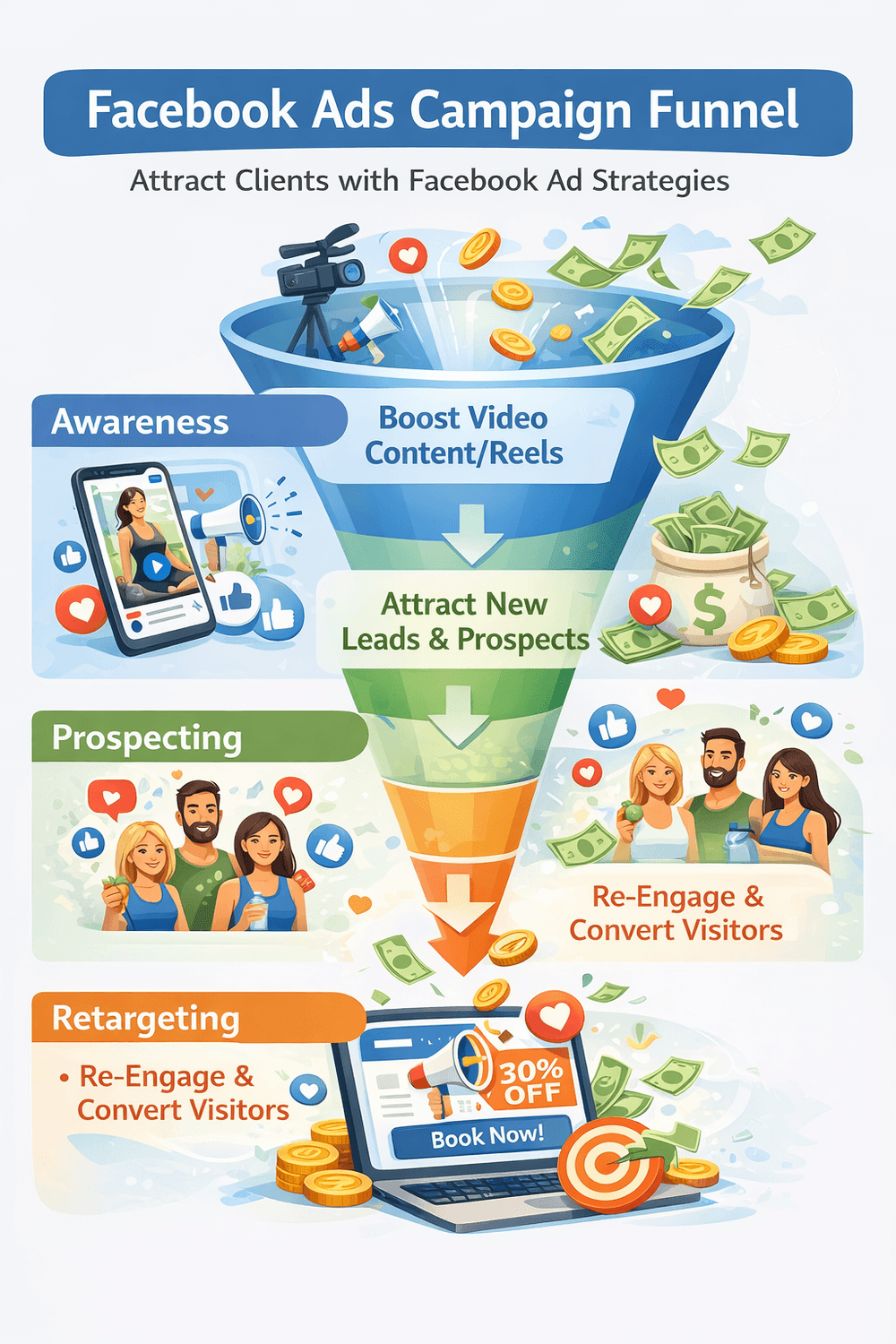
Before you launch your first campaign, create and post content on Facebook and Instagram. I find the best medium is videos. Use the boost feature to reach a wider audience.
Use this strategy for about a month and then run with a retargeting campaign.
What should your retargeting ads say?
Your messaging here is about building certainty. These people are already interested—they just need a little push.
Show credibility. Share a client result. Explain what makes your approach different. Answer common questions. Make it easy for them to take the next step.
The whole point is to turn "I'm curious" into "I'm ready to do something about this."
Common mistakes to avoid:
Don't retarget people who just saw your ad yesterday. Give it at least a few days. Don't make your retargeting audience so small that it doesn't matter. And don't just show the exact same ad again—say something new or say it differently.
Ad Set 2: How Do You Reach New People with Broad Targeting?
Your second ad set is for reaching new people. This is where you scale.
A lot of people get scared of broad targeting. They think they need to narrow down to a super-specific audience or Facebook will "waste" their money.
But here's the truth: Facebook's AI in 2025 is really, really good. When you give it data about who converts, it finds more people like that. But it can only do this if you don't strangle it with tiny audiences.
Broad targeting means you're not limiting Facebook to "women aged 35-42 who like yoga and meditation and live within 10 miles of you." Instead, you're saying, "here's my offer, here's who it's for, go find people who will be interested."
Think of it like this, Facebook isn’t casting a wide net in a vast ocean and hoping to catch big.. The algorithm isn’t targeting everything in that ocean, just the dark patches where it knows the bait will work.
Let the machine learning do the work. Give it enough time to run.
When does broad targeting work best?
It works when your creative is clear. When your offer is specific. When you've already gotten some conversions so Facebook has data to work with.
It doesn't work as well when you're brand new, and Facebook has no idea what a "good lead" looks like for you yet. In that case, you might start slightly less broad and expand over time.
What should your broad campaign ads focus on?
Keep them simple. Keep them clear. Focus on the outcome people want.
Don't try to be clever or witty. Don't hide the point under layers of storytelling. Just say what you help people with and why they should care.
"Struggling with chronic pain that doctors can't explain? I help people get to the root cause using functional movement assessments."
That's clear. That's direct. That's going to attract the right people.
How do these two ad sets work together?
Here's the beautiful part: your broad campaign brings in new people. Some of them engage with your content. Now they're warm. Now they see your retargeting ads. Now they convert.
It's a cycle. Broad brings them in. Retargeting closes the deal. Simple and effective
How Do You Actually Capture Leads Without Complicated Tech?
Once your ads are running and people are interested, you need a way to capture their information. This is where a lot of wellness practitioners panic because they think they need fancy software or a website or a whole tech stack. You don't
Why Are Facebook Instant Forms the Best Option?
Facebook has a built-in tool called Instant Forms (also called Lead Forms). Here's why they work so well:
They're fast. Someone clicks your ad, the form pops up right there in Facebook, they fill it out in about ten seconds, and it's done.
They're familiar. People are already on Facebook. They're not being sent to some random website. It feels safe and easy.
They're friction-free. Facebook pre-fills most of the information from people's profiles. Name, email, phone—it's already there. They just have to confirm and submit.
For wellness practitioners who aren't tech experts, this is perfect. You don't need to build landing pages. You don't need email software integrated. You just set up the form in Facebook, and you're good to go.
Should You Use Facebook's "Higher Intent" Feature?
Yes, definitely.
Facebook has an option called "Higher Intent" that makes people review their information before submitting. It adds one extra click, which means slightly fewer leads—but the leads you get are way better quality.
Why? Because it filters out people who are just clicking around randomly. It makes people pause for half a second and think, "Do I actually want this?"
That small moment of friction gets rid of most of the tire-kickers.
What Questions Should You Add to Your Lead Form?
You can add custom questions to your form to help qualify people. This is smart, but don't go overboard.
Add one or two meaningful questions. That's it.
Examples of good questions:
What are you hoping to get help with?
Have you worked with [type of practitioner] before?
What's your biggest challenge right now?
When are you looking to get started?
These questions help you understand if someone is actually a good fit before you reach out to them.
Here's the golden rule: Quality beats interrogation.
Don't make your form feel like a job application. Don't ask ten questions. Keep it simple. Make it easy. You can always ask more questions later when you talk to them.
What's the Right Starting Budget?
Start with $10 per day. That's it.
I know that might sound too low if you're used to hearing about people spending hundreds or thousands per day. But here's the thing: $10 per day gives you stability, which creates clarity.
When you spend $10 per day for a month, you spend $300. That's enough to gather real data. That's enough for Facebook to learn. That's enough for you to see patterns.
Compare that to spending $100 for three days, freaking out, stopping everything, and starting over. That approach burns money and teaches you nothing.
Slow and steady beats chaotic spending every single time.
Also, $10 per day aligns with real-world business realities. Most wellness practitioners can afford $300 per month. Not everyone can afford $3,000 per month right out of the gate.
How Long Should You Wait Before Making Changes?
Let your campaign stabilize. Give it at least two weeks—preferably a month—before you make any major changes.
Here's what's happening during those first couple of weeks: Facebook is in what's called the "learning phase." The algorithm is testing different versions of your ad with different people to figure out who responds best.
If you keep tweaking things, you keep resetting this learning phase. You never give Facebook a chance to actually figure it out.
I know it's hard to watch your money go out without immediate results. But constant tweaking kills momentum. You have to let it run long enough to collect real data.
When Is It Okay to Increase Your Budget?
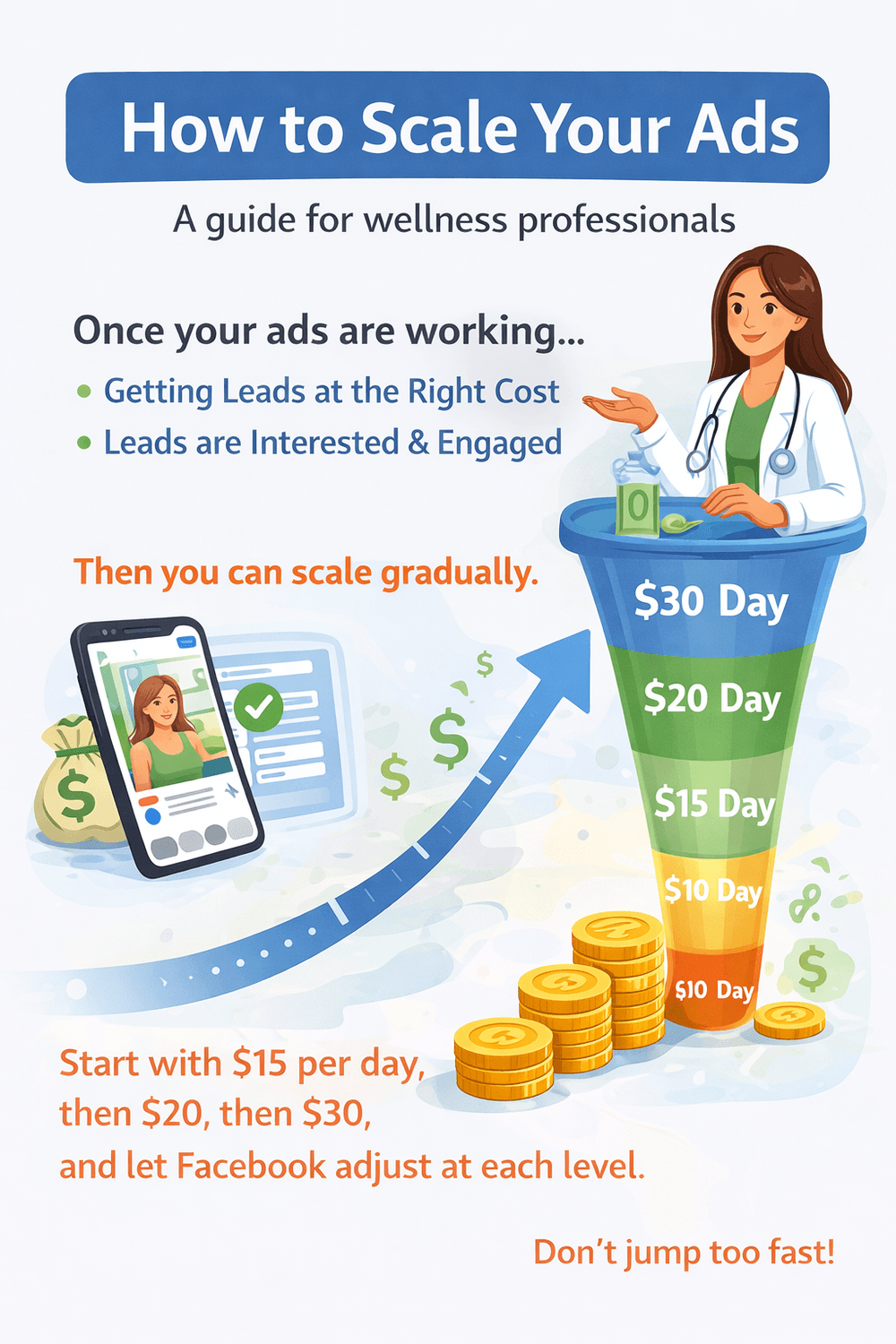
Once you have data showing that your ads are working—meaning you're getting leads at a cost that makes sense and those leads are actually interested—then you can scale.
But scale gradually. Don't jump from $10 per day to $100 per day overnight.
Try $15 per day for a week. Then $20. Then $30. Let Facebook adjust at each level.
Avoid emotional decisions. Don't double your budget because you're excited about one good day. Don't cut your budget in half because one day was rough. Use the overall trend, not daily fluctuations.
What Should You Actually Track to Know If Your Ads Are Working?
Tracking is where a lot of people either track nothing or track everything and get completely overwhelmed.
Let's keep it simple.
Is Cost Per Lead Really That Important?
Cost per lead is useful, but it's not everything.
Yes, you want to know how much you're paying for each lead. But a $5 lead that goes nowhere is worse than a $25 lead that books a call and becomes a client.
Cheap leads can still be completely useless. Don't get obsessed with driving the cost down if it means sacrificing quality.
How Do You Measure Lead Quality?
Lead quality is about three things:
Are they relevant? Do they actually match who you're trying to reach? If you help women with career issues and you're getting leads from men asking about health, that's a problem.
Are they interested? When you follow up, do they respond? Do they remember filling out the form? Or do they have no idea who you are?
Are they aligned with your service? Can they afford you? Are they in the right location? Are they ready for what you offer?
You can have a great cost per lead, but if none of them are qualified, your ads aren't working.
What's the Real Success Metric You Should Care About?
Here's the metric that actually matters: Do they move forward?
Do they reply to your follow-up message?
Do they book a call?
Do they start a real conversation?
Do they apply for your program?
This is where ROI actually lives. Not in the number of leads. In the number of leads that become conversations, and conversations that become clients.
Track this. Write it down. After 30 days, look at how many leads you got, how many responded, how many you talked to, and how many became clients.
That's your real data.
Final Thoughts: Why Building Systems Beats Running Random Campaigns
Here's what I want you to remember: Facebook ads work best when they're part of a system, not a sporadic experiment.
A system means you have a clear strategy. You know who you're trying to reach and what you want them to do.
You have a simple structure that you can run consistently. You have a way to capture leads. You have a follow-up process that turns leads into conversations.
This isn't about getting lucky with one viral post. This is about building something predictable and sustainable.
When you approach Facebook ads this way—with patience, with clarity, with simplicity—they stop feeling overwhelming. They start making sense. And they actually produce the kind of leads that turn into real clients.
You don't need to be a tech genius. You don't need a huge budget. You just need a solid plan and the discipline to let it work.
Start simple. Start small. Give it time. And build something that actually lasts
Want to Learn How to Structure Your Facebook Ad Campaign Correctly Watch This Video Next.
You Can Listen to the Full Podcast
Version Here


© All rights reserved