
How to Market Your Life Coaching Business
How to Market Your Life Coaching Business
If you're a life coach struggling to find clients who actually say yes, you're not alone. Most coaches are told to "run Facebook ads" or "build a funnel," but those generic tips don't work anymore.
Here's what does work: a complete system that attracts the right people, makes them want to work with you, and turns them into long-term clients—without feeling pushy or salesy.
This strategy comes from studying the methods of coaching pioneers such as Tony Robbins, Deepak Chopra and Mel Robbins.
Let me break down exactly how to use their best ideas for your own coaching business.
Why Most Life Coach Marketing Fails (And How to Fix It)
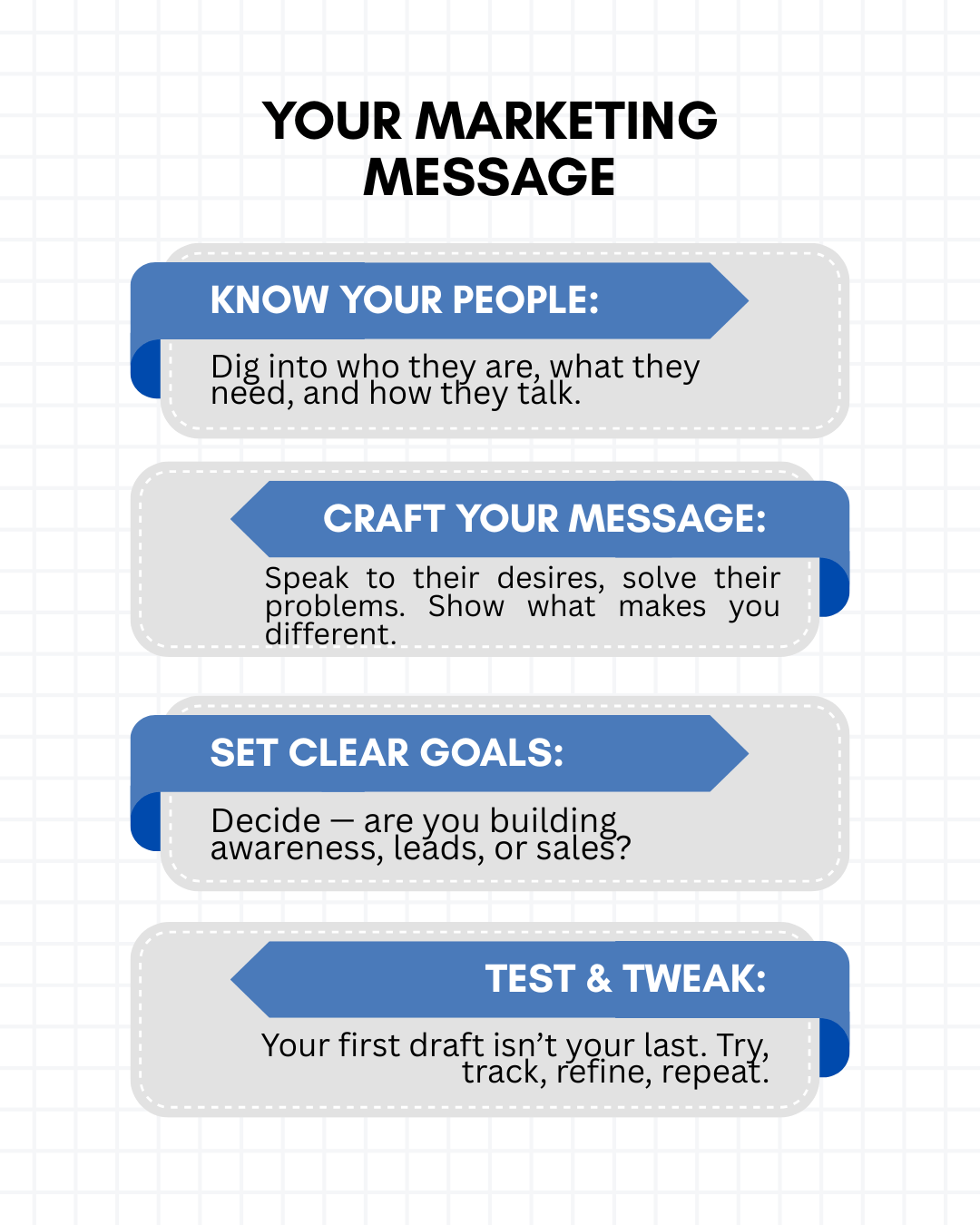
Most life coaches make one big mistake: they try to sell to everyone.
When you say "I help people find clarity and reach their goals," you're actually saying nothing at all. It's like vanilla ice cream—fine, but forgettable.
The coaches who fill their calendars do something different. They pick one specific type of person and speak directly to that person's 3 AM worries.
Put yourself in your ideal clients shows. What are their main worries, concerns, desires, and fears? What keeps them up at night?
Once you've created your ideal client avatar, create a list of their problems and pain points.
Here are four examples of specific audiences that work well:
Corporate professionals earning over $100K who feel stuck and unfulfilled
Moms whose kids just left home and don't know what's next
Entrepreneurs who built successful businesses but lost their sense of purpose
People ages 50-65 starting their second career chapter
Pick one. Build everything around that one person. You can always expand later.
Learn How Six-Figure Coaches Get High-Paying Clients On Demand. Click Below & Download Our Free Guide.
How to Create a Coaching Offer People Actually Want to Buy
Here's the problem with "free discovery calls": everyone knows it's a sales pitch in disguise. People feel tricked.
They don’t want to slog through a 60 minute consultation where they may feel rushed, or even anxious.
Instead, create something so valuable that people will pay for it—even if they never hire you for anything else.e.
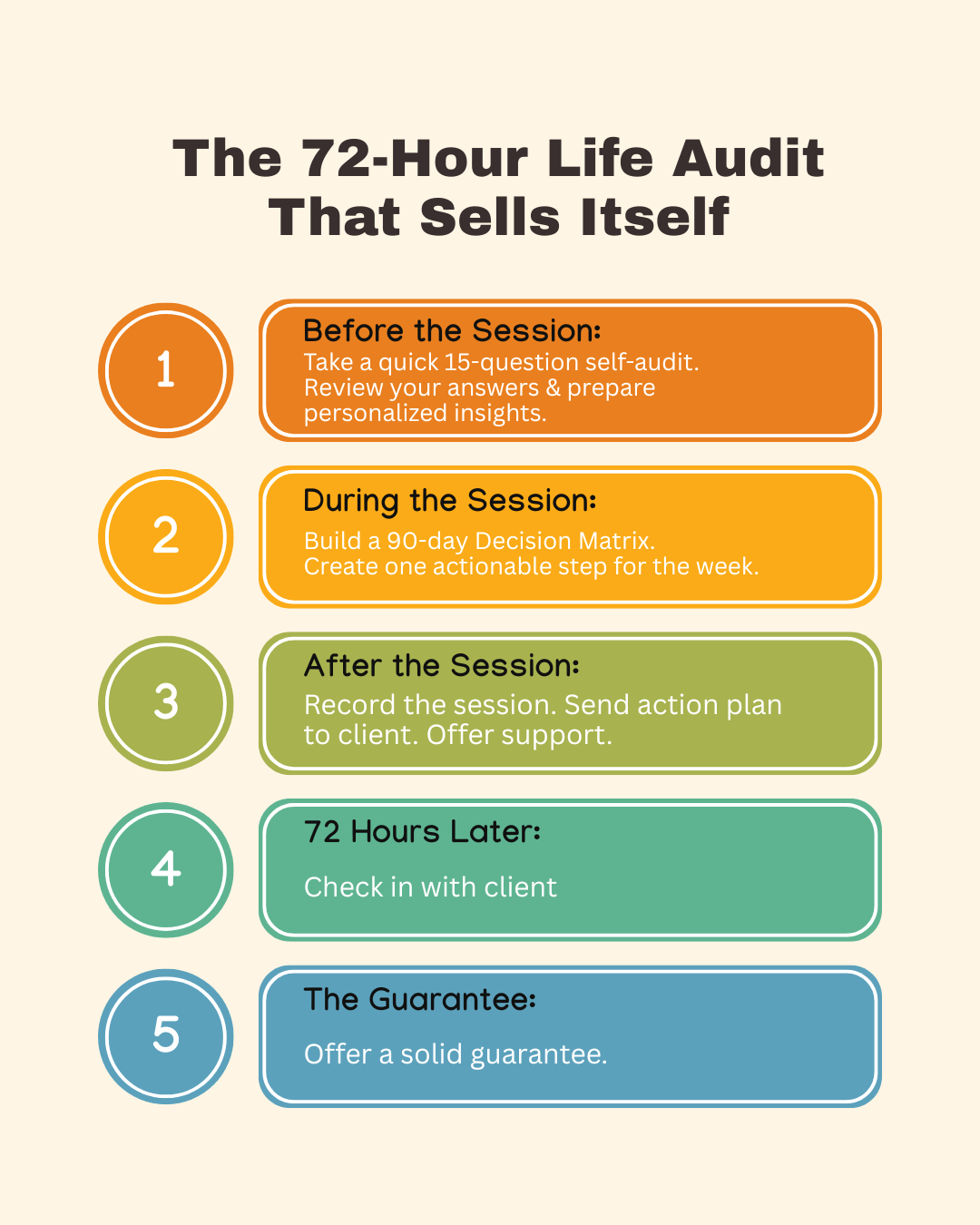
The 72-Hour Life Audit That Sells It self
Before the session:
A 15-question assessment they fill out
You review their answers and prepare personalized insights
During the 60-minute session:
Walk them through their biggest stuck point
Create a one-page "Decision Matrix" for their next 90 days
Give them one clear action step to take this week
After the session:
Recording of your time together
PDF of their personalized roadmap
Seven days of text or email support for questions
The guarantee that makes it irresistible: If they don't walk away with at least one decision they've been avoiding for six months finally clear, you'll refund $294—meaning they actually make $97 for their time.
Why charging money is better than free
When you charge, three things happen:
Serious people show up. Tire-kickers stay away.
They value it more. Free advice gets ignored. Paid advice gets used.
They're pre-qualified. Anyone paying $197 can probably afford your full coaching package.
What to Say in Your Ads (And Where to Run Them)
Forget trying to reach "everyone on Facebook." That's expensive and ineffective.
Especially now Facebook has released it’s major Andromeda update.
The old ways of doing Facebook ads is long dead. Now you want to create on two things, pain points and ad diversity.
You need to pinpoint the exact challenges your target audience is experiencing right now and develop creatives that capture their attention. Next, go where your specific audience hangs out and speak directly to their late-night worries.
The best practice is to run a broad campaign followed by a specific campaign targeting people who visited your site, watched your videos and got as far as your landing page.
Use Facebook's smart targeting features and build custom audiences for your campaign.
Start with a single ad set and use ten different creatives, each with three ad copy variations that speak directly to your audience.
You can target by job title, career changes, and life transitions
People are in a professional mindset, thinking about growth
There's less noise and competition
The ad that stops the scroll
Use a specific image that really hits home, for example, someone lying awake at 3 AM staring at the ceiling dressed in a crumpled suit.
Connect with their feelings, wants, and desires. More importantly, be specific.
Your headline: "If you're awake at 3AM asking 'Is this it, then?'
The ad copy should sound something like this:
"You've checked all the boxes. Good job. Nice house. Doing what you're supposed to do.
So why does it feel like you're living someone else's life?
Here's what nobody tells you: That 3 AM feeling isn't just stress.
It's your brain trying to tell you something.
I've spent 12 years helping [your specific audience] turn that restless feeling into a clear plan forward.
Not vague 'find yourself' advice. Real steps for your next chapter.
The 72-Hour Life Audit takes that stuck feeling and turns it into a 90-day action plan.
Most people wait 3-7 years before doing something about this feeling.
How much longer are you willing to wait?
How to Test What Works (Using Facebook's New Andromeda System)
Facebook recently changed how ads work with their Andromeda update. The old way of testing ads doesn't work anymore.
Here's what changed and what you need to do about it.
What Facebook's Andromeda update means for you
The old system let you test one thing at a time—like just changing the headline or just changing the image. That's dead.
Now Facebook's AI wants variety. It learns faster when you give it completely different ads to test, not just tiny variations.
Think of it like this: the AI is trying to figure out what makes your ideal client click. If you show it five ads that all look similar, it can't learn much. But if you show it five totally different approaches, it figures out patterns way faster.
The new way to test your ads
Create five ads that are completely different from each other. Not just different headlines—different everything.
Ad 1: The 3 AM Pain Point
Image: Person awake in bed at night, staring at ceiling
Hook: "If you're awake at 3AM asking 'Is this it, then?'"
Emotion: Anxiety and recognition of the problem
Pain point: Feeling stuck despite doing everything "right"
Ad 2: The Regret Trigger
Image: Person looking at old photos or sitting alone at a coffee shop
Hook: "Remember when you used to dream bigger than this?"
Emotion: Nostalgia mixed with disappointment
Pain point: Lost sense of purpose and passion
Ad 3: The Time Warning
Image: Calendar pages flipping or clock moving fast
Hook: "You've been saying 'next year' for how many years now?"
Emotion: Urgency without panic
Pain point: Time passing without making changes
Ad 4: The Hidden Cost
Image: Professional-looking person in nice office looking empty
Hook: "What's the real cost of staying comfortable?"
Emotion: Realization and awakening
Pain point: Trading fulfillment for security
Ad 5: The Future Self
Image: Sunrise, open road, or person looking hopeful
Hook: "12 months from now, you'll wish you started today"
Emotion: Hope and possibility
Pain point: Fear of missing out on better life
Why each ad targets a different pain point
Your ideal client isn't just one emotion. They're feeling lots of things:
Fear of wasting more time
Frustration that success didn't bring happiness
Shame for not having it figured out
Hope that things can be different
Anger at themselves for waiting so long
Each ad speaks to one of these feelings. Facebook's AI will figure out which emotion makes your specific audience click most.
How to set up your test the right way
Here's the step-by-step:
Step 1: Create one campaign Don't make five separate campaigns. Put all five ads in one campaign with Advantage+ campaign budget.
Step 2: Let Facebook's AI do its job Set your daily budget to at least $50 (for all five ads combined, not each). Facebook needs enough data to learn.
Step 3: Wait longer than you think Give it 7-10 days before checking results. The AI needs time to find your people and test different combinations.
Step 4: Look at the right numbers Don't just look at clicks. Look at:
Cost per landing page view
Cost per application started
Cost per purchase
The ad with the most clicks isn't always the winner. The ad that gets the cheapest qualified leads wins.
Step 5: Kill the losers, feed the winners After 10 days, turn off any ad that's performing 50% worse than your best one. Let Facebook spend more money on what's working.
How to keep creating fresh ads (diversifying your creatives)
Here's the problem: Facebook's AI gets bored. Your winning ad will work great for 2-4 weeks, then it stops working.
Why? Your ideal audience has seen it too many times. They start ignoring it (Facebook calls this "ad fatigue").
The solution: Always have new ads ready
Every two weeks, create 2-3 new ads to add to your campaign. Keep them completely different from what's already running.
New angles to try:
The cost of waiting: "Every month you wait is another month living someone else's life"
The breaking point: "That moment when 'fine' stops being good enough"
The permission slip: "What if you don't have to earn the right to change?"
The compound effect: "Small aligned decisions now = transformed life in 90 days"
The identity shift: "You're not lost. You're ready to become who you actually are"
New image styles to rotate:
Close-up of hands holding coffee, looking contemplative
Professional desk with an empty journal
Sunset through office window
Person on a hiking trail alone
Mirror reflection with person looking uncertain
Car dashboard at a literal crossroads
What not to do with your ads
Don't: Make tiny changes and call it a new ad (changing "Is this it?" to "Is this all?" isn't different enough)
Do: Create completely different approaches that test different emotions
Don't: Use stock photos that look fake and staged
Do: Use images that feel real and relatable (even good stock photos that look authentic)
Don't: Write long paragraphs that bury your point
Do: Make your first sentence stop the scroll, then explain
Don't: Test too many ads with too little budget ($10/day spread across 5 ads = not enough data)
Do: Spend at least $50/day total so Facebook can actually learn
How to know if Facebook ads are working for you
After 30 days of running ads (with at least $50/day budget), you should see:
10-20 landing page views per day
2-5 application starts per day
1-3 purchases per week
If you're not hitting these numbers, the problem is usually:
Your audience is too broad (go narrower on who you target)
Your offer isn't clear (rewrite your ad to focus on one specific pain point)
Your price is wrong (test $97 instead of $197, or $297 if your audience can afford it)
The simple formula for ads that work
Every good ad follows this pattern:
Call out the feeling (they're awake at 3 AM, feeling stuck, watching time pass)
Name the hidden cost (living someone else's life, wasting years, feeling empty despite success)
Offer the clear path forward (your 72-Hour Life Audit and Decision Matrix)
Create light urgency (how much longer will you wait?)
One clear button (Get My Decision Matrix - $197)
Test different feelings. Test different costs. Test different ways to frame the same solution. Let Facebook figure out what works for your specific audience.
Learn How Six-Figure Coaches Get High-Paying Clients On Demand. Click Below & Download Our Free Guide.
How to Build a Simple Funnel That Actually Convert
A funnel doesn't have to be complicated. Here's the exact sequence that turns strangers into paying clients.
Step 1: They click your ad and watch your video
Don't send people to a boring sales page. Send them to an 8-minute video where you:
Tell your story. You were once stuck like them.
Share your turning point. The moment you realized success without fulfillment isn't success.
Introduce your method. Explain your Decision Matrix framework in simple terms.
Make your offer. Walk through exactly what they get for $197.
Qualify them. Say clearly: "This isn't for everyone. If you want someone to validate staying comfortable, I'm not your person."
Only one call-to-action in the whole video. Don't confuse people with multiple buttons.
Step 2: They fill out an application (not a checkout form)
Here's a secret: don't let people buy immediately. Make them apply first.
Ask six questions:
What decision have you been avoiding?
How long have you been stuck on this? (Multiple choice: under 6 months, 6-12 months, 1-2 years, 2+ years)
What's it costing you to keep waiting?
When are you ready to make a change? (This month, next 3 months, just exploring)
Have you worked with a coach before? What happened?
On a scale of 1-10, how committed are you to taking action? (Use a slider)
Why this works:
They sell themselves by writing out their problem
You get information to personalize their experience
People who aren't serious drop off (and that's good)
If they rate themselves below 7 on commitment, send them to a waitlist instead
Step 3: Show them a personalized confirmation
Based on what they wrote, show them a custom message:
"[Their Name], based on what you shared about [specific thing they wrote], I can already see three patterns we'll address..."
Then the payment button and calendar link. They book their session right after paying.
Step 4: Send them pre-work before the session
After they buy but before you meet:
Day 1: Welcome video plus the 15-question deep assessment
Day 2: Email with three success stories from people like them
Day 3: "How to prepare" email that sets expectations
By the time they show up for the session, they're already invested and ready to go deep.
Step 5: Deliver amazing value (and mention your next level)
During the 60-minute audit, give them everything you promised. Make it so good they'd be happy even if this was all they ever got from you.
Then, at the 52-minute mark:
"We've mapped your 90 days. Here's what most people discover: they implement this, get momentum, then hit the 6-week wall where accountability becomes everything.
I have 8 spots in my 90-Day Implementation Intensive starting [specific date]. It's [your price]. I'm not pitching you right now—but if it feels like the next step, let's talk after you've sat with this for 48 hours."
That's it. Plant the seed.
What to Send After the Session (The Follow-Up Sequence)
Most coaches do the session and then... nothing. That's leaving money on the table.
Here's a simple 7-day email sequence that feels helpful, not pushy:
Day 1 email:
Subject: "Did you listen to your recording yet?"
Just check in. Remind them to review what you covered.
Day 3 email:
Subject: "Quick question (it's important)"
Body: "Hey [Name], been thinking about your Decision Matrix since our session. You said your biggest priority was [specific thing]. Have you moved on it yet? Not judging—genuinely asking. Because here's what I've noticed: most people leave our audit clear. Then life happens. And that clarity becomes another 'someday' thing. If that's happening, hit reply. Let's fix it. If you're already in motion, even better—I want to hear about it."
Day 5 email:
Subject: "She did exactly what you said you'd do"
Share a case study of someone who implemented and got results. Make it specific: their age, situation, what they struggled with, what changed.
Day 7 email:
Subject: "8 spots → 3 left"
Body: "Remember when I mentioned the 90-Day Implementation Intensive? Three spots left for [date]. Not going to do a song and dance. You know if you need this. If you implement your Decision Matrix alone: great. If you know yourself well enough to know you need accountability: this is it. Want to talk? Grab 15 minutes here: [calendar link]. Or don't—I'm good either way. Just wanted to make sure you didn't miss out!
The tone matters: Sound like a helpful friend, not a salesperson. Give them permission to say no.
Learn How Six-Figure Coaches Get High-Paying Clients On Demand. Click Below & Download Our Free Guide.
How to Turn Clients Into a Referral Machine
The smartest move? Make every client bring you more clients—without being weird about it.
After someone finishes your 90-Day Intensive successfully, offer this:
"I'll run a free 72-Hour Life Audit for three people you refer. You get to give three friends this experience at no cost to them. All I ask: they mention you sent them."
Why this works better than asking for referrals:
Your client gets to be the generous friend
Their friends get something valuable (not a sales call)
You still collect $197 per person (it's not free to them, it's free because of the referral)
Everyone wins
One client with three referrals who each refer three more? That's exponential growth.
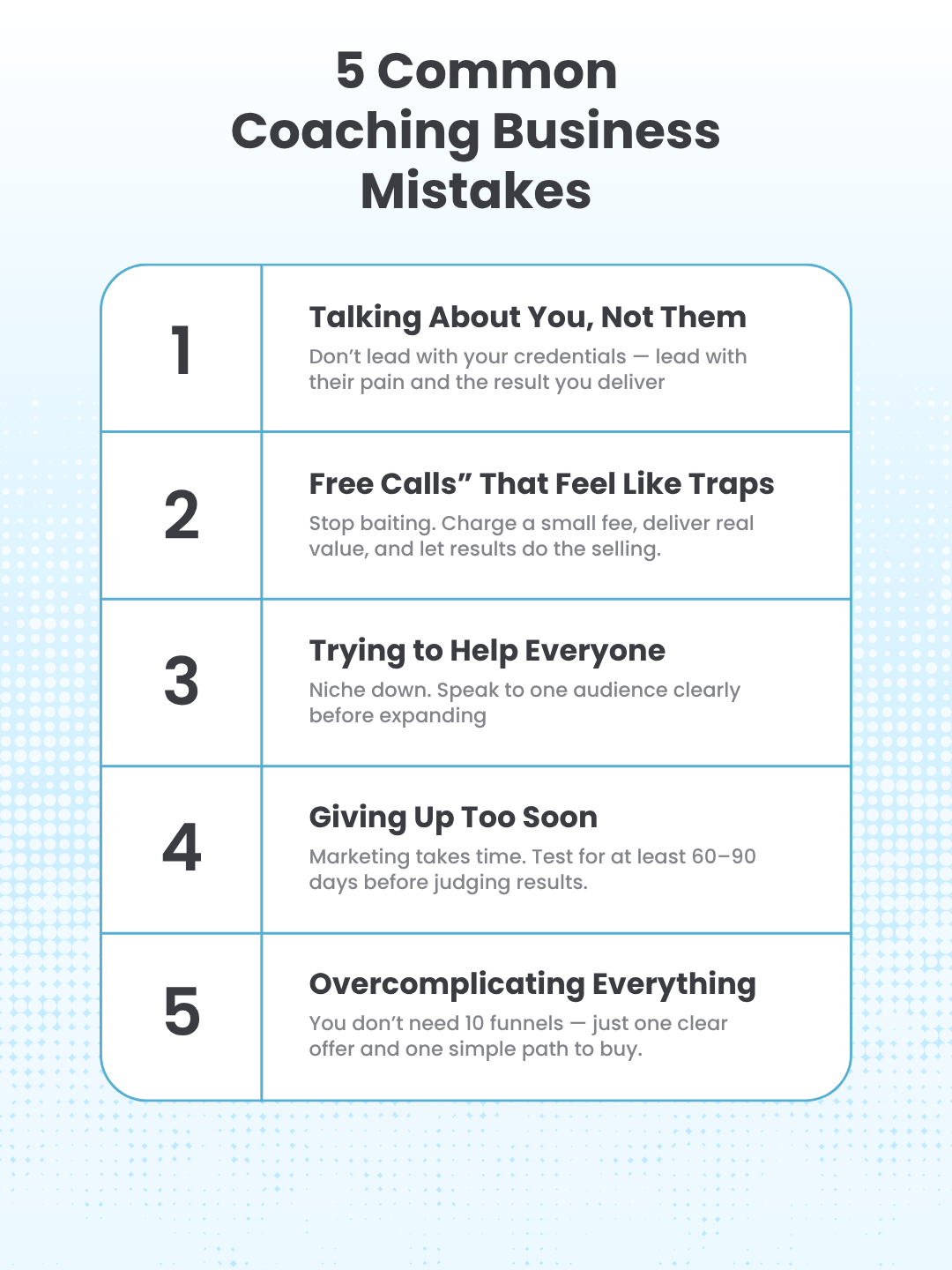
Common Mistakes Life Coaches Make With Marketing
Mistake 1: Talking about yourself instead of their problem
Your website shouldn't say "I'm a certified life coach with 15 years of experience." It should say "If you're stuck at a crossroads and don't know which way to turn, I help you get clear in 72 hours."
Mistake 2: Free discovery calls that feel like traps
People are tired of "free calls" that are just disguised sales pitches. Charge something. Deliver value. Let the quality of your work do the selling.
Mistake 3: Trying to help everyone
You can't be the coach for burned-out moms AND corporate executives AND entrepreneurs AND recent divorcees. Pick one. Master that message. Expand later.
Mistake 4: Giving up too soon
Marketing isn't magic. It takes 90 days to know if something works. Run your ads for at least 60 days before deciding they don't work.
Mistake 5: Making it too complicated
You don't need a dozen funnels and automation sequences. You need one clear offer, one simple path to get it, and one way to go deeper with you.
What Actually Matters
People don't buy services for purely logical reasons. That's why you want to position your coaching as a life changing decision.
Think beyond the immediate features and benefits of your niche. Formulate a benefits matrix and add it to your landing page copy:
It speaks to a specific person's specific pain
It removes the risk of trying you out
It leads with value, not pressure
It makes the next step obvious without being pushy
It turns happy clients into your marketing team
Start simple. Pick your audience. Create your $197 offer. Write one good ad. Build a basic funnel. Send your follow-up emails.
Then do it consistently for 90 days.
The coaches who win aren't always the most talented. They're the ones who show up with a clear message, a strong offer, and the patience to let the system work.
Frequently Asked Questions About Life Coach Marketing
Don't offer free discovery calls—charge between $97 and $297 instead. Here's why: free calls attract tire-kickers who ghost you or can't afford your services anyway. When someone pays even $197, they show up prepared, take it seriously, and are already qualified as potential clients.
The sweet spot for most coaches is $197 for a 60-90 minute session that includes real value—not just a sales pitch. Give them a personalized roadmap, a framework they can actually use, and follow-up support. If they love the experience, selling your full coaching package becomes natural because you've already proven your worth.
Think of it this way: if someone won't invest $197 to test-drive working with you, they definitely won't invest $3,000+ for your full program.
LinkedIn beats Facebook and Instagram for most life coaches, especially if you work with professionals, executives, or people in career transitions. Here's the deal: people scroll Facebook for entertainment and Instagram for inspiration, but they go to LinkedIn thinking about their career, growth, and next steps.
LinkedIn lets you target by job title, career changes, and industry. You can reach "people who changed jobs in the last 90 days" or "VPs at tech companies"—that's gold for coaches who specialize in professional transitions or executive coaching.
That said, if you coach stay-at-home moms or creative entrepreneurs, Facebook groups and targeted ads might work better. The real answer? Go where your specific ideal client hangs out, not where someone told you to be.
Expect 30-60 days before you see consistent results, and that's if you're doing everything right. Facebook's AI needs time to learn who your ideal client is and where to find them.
Here's a realistic timeline: Week 1-2, you're spending money and getting data but probably no sales. Week 3-4, you might get your first few clients. By week 6-8, if your ads and offer are good, you should see a steady flow.
The biggest mistake? Coaches spend $500, get discouraged after two weeks, and quit right before things would've worked. Set aside at least $1,500-$2,000 for your first 60 days of testing. That's $25-35/day, which is the minimum Facebook needs to gather useful data.
Also, your first round of ads probably won't be winners. You'll need to test different images, headlines, and pain points before you find what clicks with your audience.
Stop talking about yourself and start talking about their 3 AM thoughts. The ads that work don't say "I'm a certified life coach with 15 years of experience." They say things like "If you're lying awake wondering 'Is this really it?'—read this."
Here's the formula: Start with a specific feeling they're having right now. Something like:
"You've checked all the boxes. Good job. Nice income. Doing what you're supposed to do. So why does Sunday night fill you with dread?"
Then acknowledge what they're going through isn't just stress—it's a signal. Don't promise to "transform their life" (too vague). Instead, promise something concrete: "I'll help you make the one decision you've been avoiding for six months."
The best-performing ads for coaches use real emotions (anxiety, frustration, feeling stuck) paired with specific outcomes (clear next step, 90-day plan, one big decision made). Skip the inspirational quotes and stock photos of people jumping on beaches. Get real.
You can send them straight to a calendar, but you'll waste money and get flaky bookings. Here's what happens: someone clicks your ad in a moment of emotion, books a call, then by the time the call comes around three days later, they've talked themselves out of it or forgotten why they cared.
A simple funnel solves this. At minimum, you need:
A short video (5-8 minutes) that tells your story and explains your approach
An application form that makes them write out their problem
A confirmation page that addresses what they wrote
That's it. You don't need complicated software or 47 different pages. This simple three-step process does two things: it pre-sells them on you, and it makes them invest mental energy (filling out the application) so they don't ghost.
Think of the funnel as the bouncer at a club. It lets the right people in and keeps the wrong people out. You want clients who show up ready to work, not people who are "just looking.
If you can't describe your ideal client's exact problem in one sentence, you're too broad. If you've run ads for 30 days with decent budget ($30+/day) and gotten zero leads, you might be too narrow.
Here's the test: Can you finish this sentence in 10 words or less? "I help [specific person] who [specific problem] get [specific outcome]."
Too broad: "I help people find clarity and reach their goals." Too narrow: "I help top-tier accountants over 50 living in Denver bolster their career choices." Just right: "I help burned-out executives making $150K+ who feel successful but unfulfilled."
Another way to check: Go to Facebook ad manager and type in your targeting criteria. If it says your potential audience is under 50,000 people, you might be too narrow (unless you're in a small country). If it says 5 million+, you're definitely too broad.
Start narrow. You can always expand later. But starting broad means you're trying to talk to everyone, which means you're connecting with no one.
Andromeda is Facebook's new AI system that changed how ads work starting in late 2024. The old way was testing tiny variations—like the same ad with three different headlines. That doesn't work anymore.
Now Facebook's AI wants variety. It learns faster when you give it completely different ads—different images, different emotional hooks, different pain points.
Think of it like this: the AI is trying to figure out what makes your people click. If you show it five almost-identical ads, it can't learn much. But five totally different approaches? Now it can spot patterns.
What this means for you: Create 5 different ads that each target a different emotion your ideal client feels. One ad about anxiety (lying awake at 3 AM), another about regret (remember when you used to dream bigger?), another about time pressure (you've been saying "next year" for how long?).
Run them all in one campaign and let Facebook figure out which emotional trigger works best for your specific audience. Stop making tiny tweaks. Start making bold, different versions.
Run 5 completely different ads in one campaign. Not 5 similar ads—5 ads that look and sound totally different from each other.
Give it 7-10 days before you check results. I know that's hard when you're spending money, but Facebook's AI needs time to test your ads with different people at different times of day. Checking every day and making changes just confuses the system.
After 10 days, look at these numbers (not just clicks):
Cost per landing page view
Cost per application started
Cost per purchase
Turn off any ad that's performing 50% worse than your best one. Keep the winners running and add 2-3 new ads every two weeks to fight "ad fatigue" (when your audience gets tired of seeing the same ad).
Budget-wise, you need at least $50/day total for all 5 ads combined. Less than that and Facebook doesn't have enough money to properly test. If you can't afford $50/day, start with 3 ads at $30/day instead of 5.
If your budget is still tight, use Facebook's built-in instant forms feature to generate leads. This will help you slash costs while still capturing leads. Make sure you use qualifying questions to eliminate tire kickers.
Start with $5 per day. Gradually scale your ad spend with winning ads.
This is super common and fixable. No-shows usually mean people aren't invested enough between paying and showing up.
Here's what to do: Send three emails before their session.
Day 1 (right after purchase): Welcome video plus the pre-work assessment. Make them fill something out. When they do work before the session, they show up.
Day 2: Send success stories of people just like them. This reminds them why they bought and gets them excited.
Day 3 (day before session): "How to prepare" email. Tell them what to have ready, what to expect, even what not to do (like don't drink three coffees right before—you want them calm and focused).
Also, make them book their session time slot immediately after paying. Don't let them pay and then "book later." Later never happens.
If you do all this and still get no-shows, add a $50 no-show fee to your terms. When people know they lose money for not showing up, they magically find a way to make it.
Don't ask for referrals. Give them an excuse to refer.
After someone finishes your full coaching program (not the $197 audit—your main package), offer this: "I'll give three of your friends a free 72-Hour Life Audit. You pick who gets it. All they need to do is mention you sent them."
This works because:
Your client looks generous, not salesy
Their friends get something valuable (your $197 audit for free)
You still get paid $197—their friend doesn't pay, but the referral credit covers it
Everyone wins
The key word is "give." Don't say "Do you know anyone who needs coaching?" That puts pressure on them and makes it weird. Instead, you're giving them three gifts to hand out to people they care about.
One happy client with three referrals who each convert and refer three more? That's nine new clients from one person. That's how coaches fill their practice without spending a fortune on ads.
The only rule: only offer this to clients who got amazing results. If someone didn't implement or wasn't happy, don't ask them to refer. You want referrals from raving fans, not people who are just being polite.


© All rights reserved