
Google Ads for Wellness Practitioners: A Simple Guide to Getting Found by the Right Clients
Google Ads for Wellness Practitioners: A Simple Guide to Getting Found by the Right Clients
You've probably heard Google Ads can bring new clients to your practice. Maybe you've even tried it—set up a campaign, watched your budget drain, and wondered why the phone wasn't ringing.
Here's what most wellness practitioners don't realize: Google Ads works differently now than it did even two years ago.
The old playbook—picking exact keywords, writing one perfect ad, crossing your fingers—doesn't match how people actually search for help anymore.
This guide breaks down what's changed, why it matters for your practice, and how to set up campaigns that connect you with people who genuinely need what you offer.
To help you set up your first Google ads campaign, I've included a complete walkthrough video the the end of this blog post. The video will guide you through every stage of the set up.
Read through the entire blog post then watch the full video.
Scroll right to the end of this page to find the video tutorial.
Why People Search Differently Now (And What That Means for You)
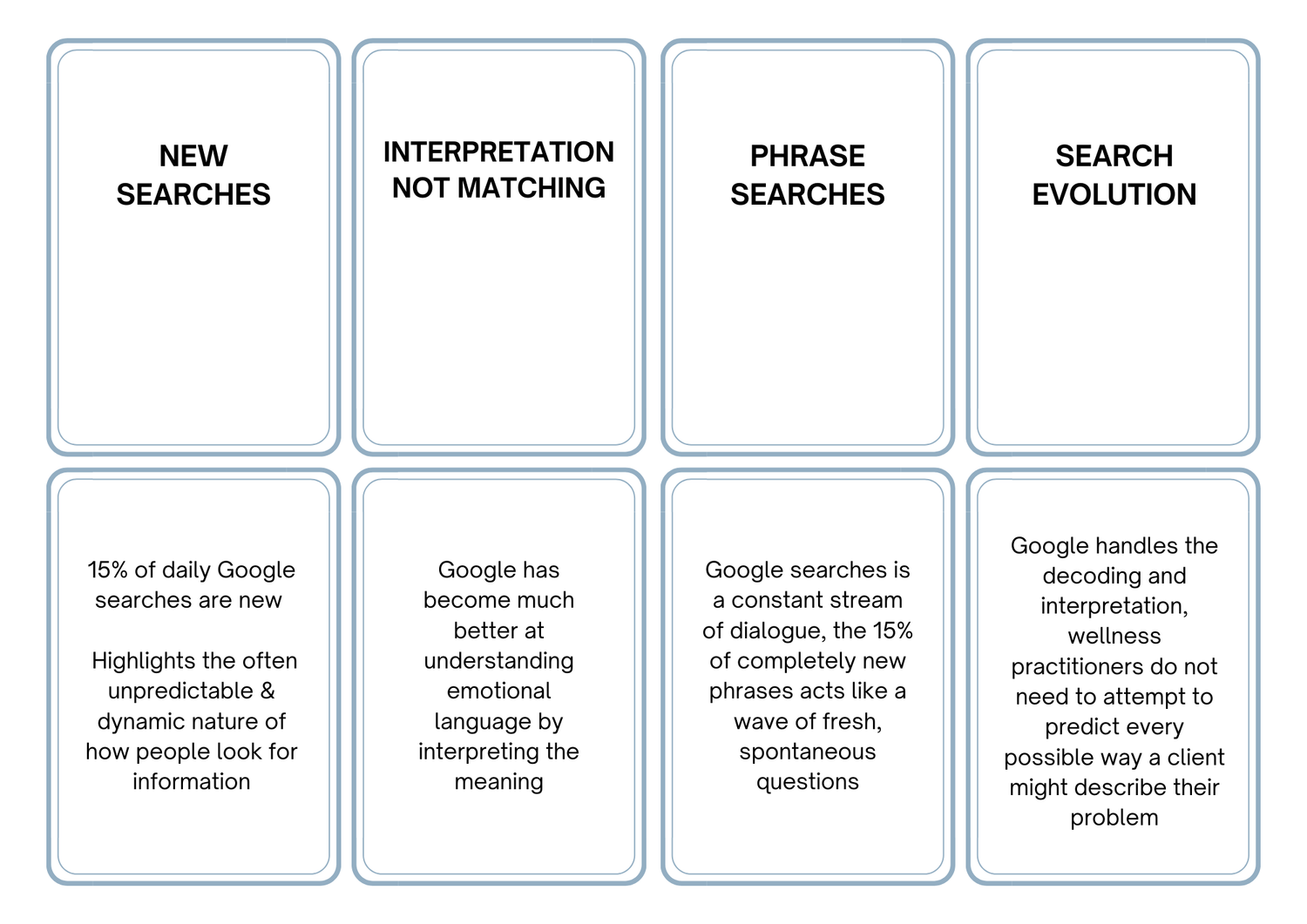
Every day, Google processes billions of searches. About 15% of them are completely new—phrases no one has ever typed before.
Think about how your clients describe their problems when they first contact you.
They rarely say "I need cognitive behavioral therapy for generalized anxiety disorder." Instead, they say things like:
"Why do I feel panicky every morning?"
"Can't straighten my back after sitting"
"Constantly tired no matter how much I sleep"
These aren't technical service descriptions. They're real human experiences, typed into a search bar at 2 AM or during a lunch break.
Google's gotten much better at understanding this messy, emotional language. The platform doesn't just match words anymore—it interprets meaning.
Someone searching "feel stressed all the time" might see ads from therapists targeting "anxiety counseling," even though those exact words don't match.
This shift is good news for wellness practitioners. You don't need to predict every possible way someone might describe their problem. You need to be present when they're looking for help, however they choose to ask for it.
Understanding Keyword Match Types Without the Jargon
When you add keywords to your Google Ads campaign, you choose how closely someone's search needs to match those keywords before your ad shows up.
There are three main options:
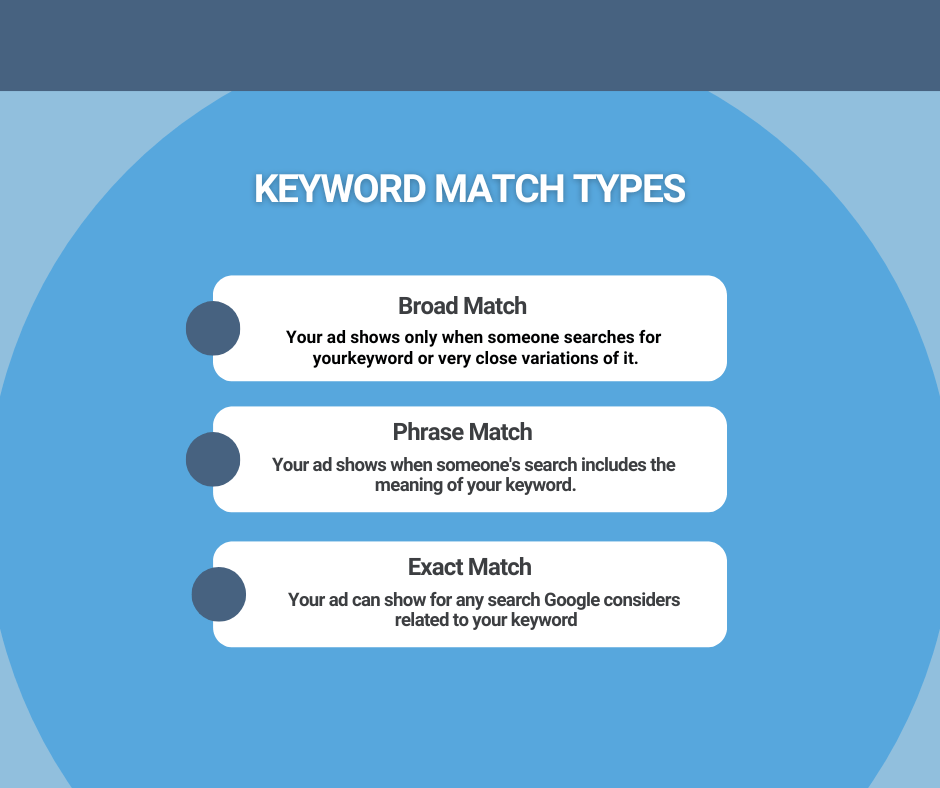
Exact Match: The Narrow Door
Your ad only appears when someone types something very close to your keyword. If you target "sports massage therapy," your ad shows for that phrase and close variations—but not "deep tissue massage" or "muscle pain treatment."
This works when people already know what they're looking for. Think of it as someone calling your clinic and asking for you by name.
Phrase Match: The Middle Ground
Google shows your ad when someone's search includes the meaning of your phrase, even if they use different words.
Target "help with anxiety" and your ad might show for "ways to manage anxious feelings" or "therapy for constant worry."
This catches variations while keeping some control over who sees your ads.
Broad Match: The Wide Welcome Mat
Your ad can appear for any search Google thinks relates to your keyword, based on lots of signals—your website content, other keywords in your campaign, the searcher's location, what they've looked at before.
Target "back pain treatment" and someone searching "can't bend over without hurting" might see your ad. Or "sciatic nerve problems." Or "need chiropractor near me."
This feels risky at first. Won't you waste money on irrelevant searches?
Actually, when paired with smart bidding (more on this in a moment), broad match often performs better than narrow targeting—especially for wellness services where people describe symptoms and feelings, not diagnoses and treatment names.
Why Local Search Campaigns Beat Performance Max for Wellness Practices
Here's something most wellness practitioners discover the hard way: a locally focused Google Search campaign typically outperforms Performance Max (PMAX) or other AI-driven "smart" campaigns.
Why?
Search campaigns connect you with active intent. Someone typing "therapist near me" or "chiropractor open today" is actively looking for help right now. They need an appointment, not a brand awareness exercise.
PMAX casts a wider net—sometimes too wide. These campaigns run across Google's entire network: Search, Display, YouTube, Gmail, Discover feeds. Sounds great in theory. In practice?
Your budget gets spread thin showing ads to people who aren't ready to book, aren't in your area, or are just browsing YouTube videos.
Local wellness services need local visibility. You're not Amazon. You can't serve customers nationwide. A tightly focused Search campaign keeps your ads in front of people in your city who are searching with purpose.
PMAX might show your ad to someone three states away watching cat videos—not exactly your ideal client.
You maintain more control. With Search campaigns, you see exactly which keywords trigger your ads, what people searched for, and where your budget goes. PMAX operates more like a black box.
Google handles everything automatically, which sounds convenient until you realize you're paying for clicks that have nothing to do with your services.
For most wellness practitioners with local practices and modest budgets, a well-structured Search campaign using broad match keywords and smart bidding delivers better results than letting PMAX spray your message everywhere.
Save the fancy AI campaigns for later. Start with what works: showing up when your neighbors search for help.
How Google Decides Which Ad to Show Your Potential Client
Understanding this process helps you see why simpler campaigns often work better than complex ones.
When someone types a search, Google runs through these steps in milliseconds:
Figures out what they actually want. Not just the words—the intent behind them.
Checks which advertisers' keywords are eligible. This includes your match type settings and negative keywords (searches you've told Google to avoid)
Builds the best version of each advertiser's ad. If you're using responsive ads (you should be), Google assembles headlines and descriptions most likely to resonate with this specific person.
Calculates the right bid. If you're using smart bidding, Google looks at hundreds of signals—time of day, device, location, browsing history—to determine how likely this person is to become your client.
Runs the auction. This isn't just about who bids highest. Google weighs your bid against your ad quality and expected impact. A relevant, helpful ad can win at a lower price than an irrelevant one.
Shows the winner. Here's the part that surprises people: Google won't show two of your own ads competing against each other. If someone's search matches multiple keywords you're targeting, Google picks your most relevant one. This means you don't need exhaustive keyword lists trying to cover every angle.
Why Keyword Research Actually Matters (More Than You Think)
Here's an uncomfortable truth: keyword research forms the foundation of every effective Google Ads campaign. Skip this step, and you're essentially running a blind campaign—handing piles of cash to Google to spend however it sees fit.
That's not strategy. That's hope with a credit card attached.
Effective keywords ensure your ads are discovered by the right people at the right time in their journey. Someone searching "what causes lower back pain" is in a different place than someone searching "chiropractor open Sunday near me." Both might eventually become clients, but they need different messages at different moments.
Without proper keyword research, you can't make these distinctions. You end up showing the same generic ad to everyone, wondering why your phone isn't ringing despite the clicks adding up.
What Good Keyword Research Looks Like
Start by listening to how your actual clients describe their problems. Not how you'd describe them in professional language—how they talk about them during intake calls or first appointments.
A therapist might discover people search for:
"can't stop worrying about everything"
"feel sad all the time for no reason"
"panic attacks at work"
Not "cognitive behavioral therapy" or "evidence-based treatment modalities."
A chiropractor might find searches like:
"sharp pain when I turn my neck"
"back hurts after sitting all day"
"hip won't stop clicking"
Not "spinal manipulation" or "musculoskeletal adjustment."
The Three Types of Keywords You Need
Problem-aware keywords (early journey):
"why does my shoulder hurt"
"signs of anxiety disorder"
"what causes sciatica"
These people know something's wrong but haven't decided on a solution yet. They're researching, learning, trying to understand what's happening.
Solution-aware keywords (middle journey):
"physical therapy for shoulder pain"
"best treatment for anxiety"
"non-surgical sciatica relief"
They've moved past "what's wrong" to "what fixes this." They're comparing options and approaches.
Action-ready keywords (late journey):
"chiropractor near me open now"
"book anxiety therapist online"
"physical therapy appointment today"
These are your money keywords. People ready to pick up the phone or fill out a form.
How This Prevents Wasted Spend
Without researching these distinctions, you might bid the same amount for someone casually browsing health information as you do for someone trying to book an appointment today. That's like paying the same price for a window shopper and someone walking in with their wallet open.
Keyword research helps you understand:
Which searches are worth paying more for (high intent)
Which searches need nurturing first (early research)
Which searches are completely irrelevant (your negative keyword list)
It also reveals search volume. Maybe you think "holistic wellness coach" is your main keyword, but only 20 people per month search for it in your city. Meanwhile, "help with work stress" gets 800 searches. That's valuable information before you spend a dollar.
The Simple Research Process
Make a list of 10-15 ways your clients describe their problems (use their actual words from conversations)
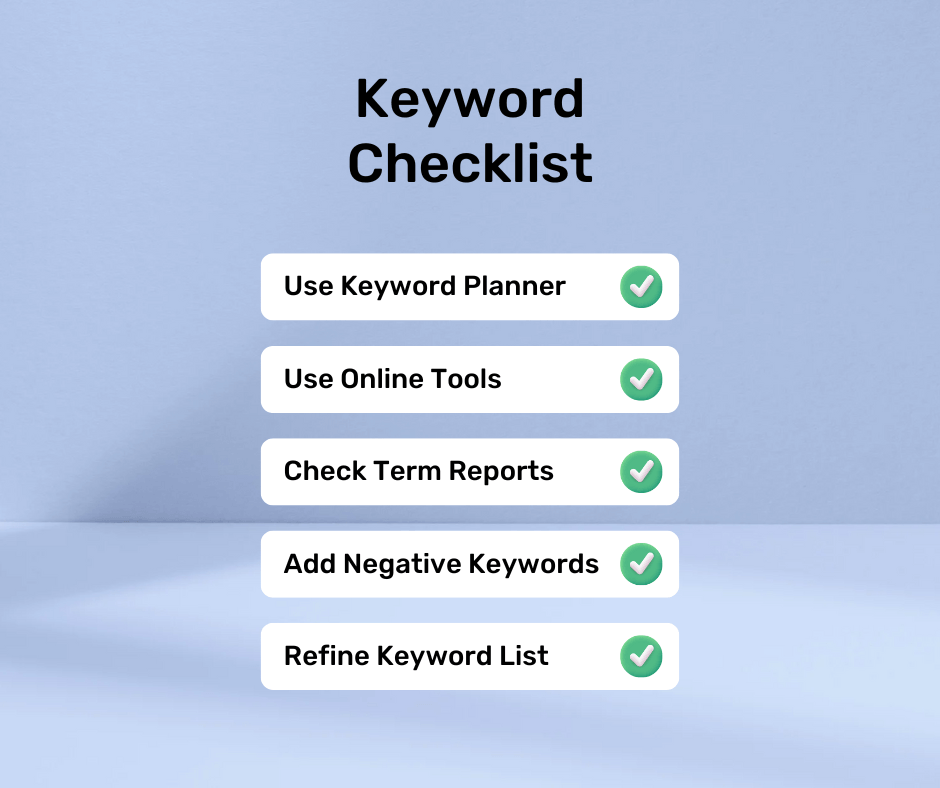
Use Google's Keyword Planner (free with any Google Ads account) to see search volumes and related terms
Look at "People also ask" and "Related searches" at the bottom of Google results pages—these show you exactly what people are curious about
Check your search terms report weekly once your campaign runs—this shows what people actually typed before clicking your ad
Add negative keywords for searches that are clearly wrong (like "free" if you don't offer free services, or specific conditions you don't treat)
The Bottom Line
Keyword research isn't busy work before the "real" campaign starts. It is the campaign. Everything else—your ad copy, your landing pages, your budget allocation—flows from understanding what people are searching for and why.
Spend a few hours on research now, or spend a few hundred dollars on irrelevant clicks later. Your choice.
Keep Your Campaign Structure Simple
Here's where wellness practitioners often overcomplicate things. You don't need dozens of campaigns with hundreds of ad groups and thousands of keywords.
Start with this structure:
One campaign = One goal
Don't mix "book appointments" with "download my guide" with "join my email list." Pick one conversion action per campaign. This gives Google's AI clear direction about what success looks like.
One ad group = One theme
Group related keywords together. A therapist might have:
Anxiety therapy ad group
Trauma therapy ad group
Depression counseling ad group
A chiropractor might organize by:
Lower back pain
Neck and shoulder issues
Sports injuries
This isn't about rigid categories. It's about keeping related searches together so Google can understand the context and
show relevant ads.
Why does simplicity matter? Because machine learning needs data to improve. Spreading your budget thin across too many campaigns means each one gets limited data.
Consolidating into fewer, focused campaigns gives Google more signals to work with, leading to better optimization and results.
Think of it like having an organized treatment room versus a cluttered one. Everything flows better when there's less chaos.
Track What Actually Matters
Google Ads only works if you measure the right things. "Traffic" and "clicks" don't pay your bills. Appointments and clients do.
Set up conversion tracking for actions that matter:
Phone calls (these often matter most for local wellness practices)
Contact form submissions
Appointment bookings
Free consultation requests
Email signups (if that's a genuine step in your client journey)
Without conversion tracking, smart bidding has nothing to learn from. It's like trying to get better at something without knowing if you're improving.
Google needs to see: "This person clicked, then called. That person clicked, then left. This one booked an appointment. That one just browsed."
Over time, patterns emerge. Google learns what a likely client looks like—their search behavior, when they search, what device they use. Then it finds more people like them.
The setup takes about 30 minutes. The impact on your results is massive.
A Simple Starting Point That Actually Works
If you're setting up Google Ads for the first time (or restarting after a failed attempt), try this:
Week 1: Foundation
Choose one specific goal (probably "book appointments")
Create one campaign
Add 5-10 broad match keywords related to your core service
Write 10-15 headlines and 3-4 descriptions for responsive ads
Set up conversion tracking for calls and form fills
Turn on smart bidding (start with "Maximize conversions" if you're not sure about target costs yet)
Week 2-4: Observation
Check your search terms report weekly
Look for patterns in what's working
Add negative keywords for obviously irrelevant searches (but be conservative—don't block potential clients)
Let the campaign run without major changes (Google's AI needs time to learn)
Month 2+: Optimization
Review which keywords drive actual appointments
Test new headline and description combinations
Adjust your budget based on results
Expand to additional services once you've proven the model works
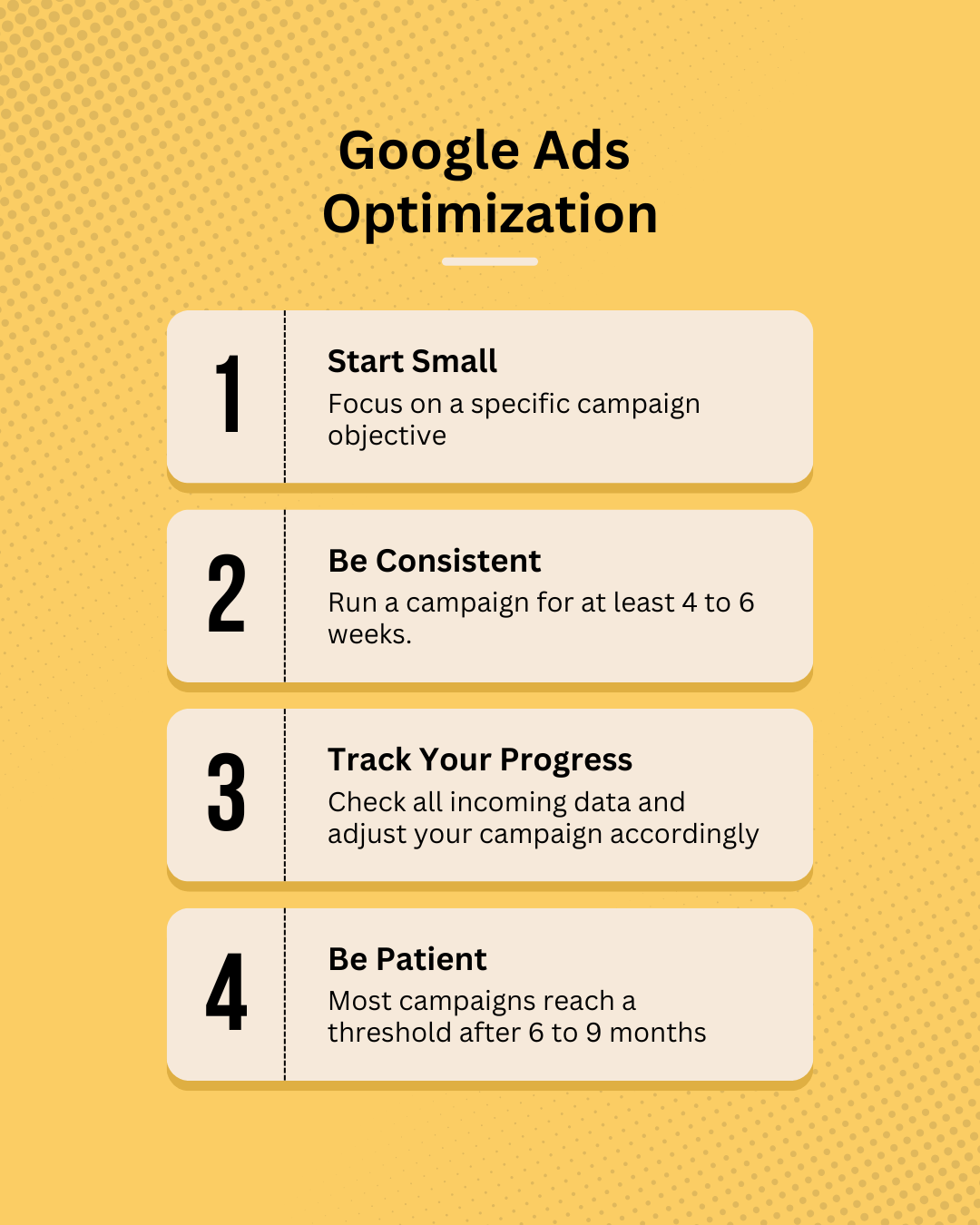
The key is patience. Smart bidding typically needs 30-50 conversions before it stabilizes.
If you're getting 2-3 appointments per week, that's 4-6 weeks of data gathering. During this learning period, costs might be higher and results inconsistent. That's normal.
Common Mistakes That Waste Your Budget
Overthinking keyword selection. You don't need 200 keywords. Start with 10 that represent how people describe their main problem.
Using too many exact match keywords. Unless people reliably search for your exact service using your exact words, you're limiting your reach.
Pausing campaigns too soon. Stopping and starting prevents Google from learning. Commit to at least 60 days unless something is drastically wrong.
Ignoring your website. Google reads your landing pages to understand what you offer. If your website is vague or generic, the AI won't be able to match you with relevant searches. Clear, specific service pages are extremely helpful.
Setting bids manually. Unless you have extensive PPC experience, smart bidding almost always outperforms manual bidding. Let the AI do what it's good at.
Not tracking phone calls. Many wellness bookings happen by phone. If you're only tracking form fills, you're missing most of your results.
Final Tips
Google Ads isn't about mastering technical complexity. It's about showing up when someone needs help, with a message that makes them feel understood.
The platform has evolved to do the heavy lifting—interpreting messy human searches, testing different ad variations, calculating optimal bids, learning from patterns. Your job is simpler than it's ever been: be clear about what you offer, who it helps, and what you want people to do next.
Start with one focused campaign using broad match and smart bidding. Give Google good conversion data. Let it learn for 60 days. Then scale what works.
Most wellness practitioners who fail with Google Ads either overcomplicate the setup or quit before the system has time to learn. The ones who succeed keep it simple and stay consistent.
You don't need to become a marketing expert.
You need a straightforward system that connects your expertise with people actively searching for help. That's what Google Ads can do—when you let it.
Full Google Ads Tutorial
You Can Listen To The Full Podcast Version Here


© All rights reserved